
Fieldnotes
People Who Measure
This project follows the scientists who go toward radiation contamination rather than away from it. Working alongside biologist Tim Mousseau, I document his slow, exacting labor of turning a landscape into data: catching barn swallows across numerous homesteads, ringing them, measuring wing and bill, and collecting blood. I also watch students and field hands grind horse, sheep, or cow bones, catch insects, and take radiation measurements. Getting our team onto the former Soviet nuclear test site in what is today Kazakhstan is its own kind of fieldwork. We need the drivers, the routes, the permissions, all carried out in partnership with colleagues in Karaganda and Semey, whose knowledge of this terrain makes the work possible. We will do all this again next year because according to conventional science, we need more samples. But most of the people who inhabit this land seem to already know the answer to the question the science team is asking: has radiation impacted the biological makeup of life on this land? By collecting more samples, this is how scientists transform local knowledge into what they describe as unbiased data points, ones that lead to facts.

Two people look out at the steppe. The instrument on the ground reads what neither of them can see.
The Polygon, or the Semipalatinsk Nuclear Test Site, does not look like a place where bombs were tested. It looks like open steppe. Horses, cows, grass, sky, families living on land that was never quite the same after nuclear testing stopped. The danger here barely leaves a mark the eye can read. Radiation is completely invisible. It surfaces only through the occasional crater from a nuclear blast, but mostly from instruments, samples, and the bodies of the animals that live in it. This is why Tim and his team gather data on survival rates, deformed beaks, numbers on a meter.
This is an anthropological study of measurement itself, of how a place becomes legible as contaminated, and what that knowledge is, and isn't, allowed to mean, and why conclusions are hard to pinpoint. I want to turn the anthropological lens onto the scientists themselves to understand what scientific knowledge does and what it fails to do, depending on which side of the East/West divide it's produced in. This is a story of an epistemic regime that produces specific outputs. These photographs are from that work: the steppe, the people who live on it, the scientists at their instruments, and the evidence that holds what none of us can see.

Lake Chagan fills a crater left by a 1965 nuclear cratering test. The water is real. So is what's in it.
aerial drone footage by Timothy Mousseau


A chaban. His house is several kilometers from Degelen. He has always grazed his sheep there.

Mare's milk, drawn every two hours, dawn to evening.

The milk ferments in the sun. It will be sold in Semey.
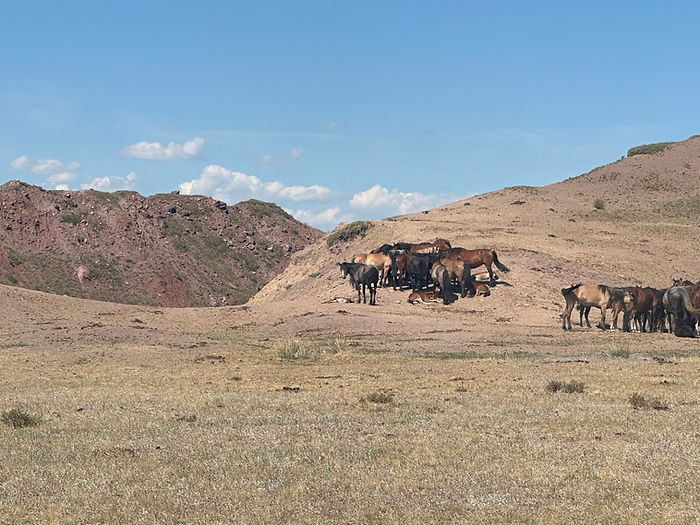
The horses gather at the crater for the water, the shade, and the wind that keeps flies off.

The work itself: a bird in hand, measured and ringed, to see who comes back next year.

The landscape becomes data at two folding tables: a row of vials, a clipboard, a caliper, animals behind.

Bones collected, bagged, and labled.

A barn swallow. Everything the work measures begins here.

A sample in one hand, a geiger counter beneath it. This is the moment when contamination becomes visible.

Americium-241 named in the field. The instrument registers what the eye cannot.

A dead Saiga on the steppe.


The steppe always takes the ruins back.

Magdalena Stawkowski, zimovka, 2026.